How to Buy XRP: Complete Step-by-Step Guide
Last Updated: February 18, 2026 · XRP Price at Time of Update: ~$1.36 USD
To buy XRP, select a cryptocurrency exchange such as Coinbase or Kraken, complete identity verification, deposit funds, and place a buy order. The process takes 10–30 minutes and requires a government-issued ID and funded payment method.
XRP is the native digital asset of the XRP Ledger, a blockchain designed for fast cross-border payments with transactions settling in 3–5 seconds at a cost below $0.01. Since the SEC concluded its lawsuit against Ripple Labs in August 2025—confirming that XRP sold on exchanges is not a security (SEC Litigation Release No. 26306, May 8, 2025; appeals dismissed August 7, 2025)—every major US cryptocurrency exchange has restored full XRP trading access for American residents. Buyers in the UK, EU, Canada, Australia, and Singapore also have broad exchange access, with XRP trading pairs available against USD, EUR, GBP, AUD, CAD, and JPY on most global platforms.
This guide covers the complete XRP purchase process: selecting an exchange, funding your account, executing your first buy order, and understanding the fees involved at each stage. Whether you plan to buy XRP with a credit or debit card for speed or use a bank transfer for lower costs, the steps below apply to every method and platform.
How Do You Buy XRP Step by Step?
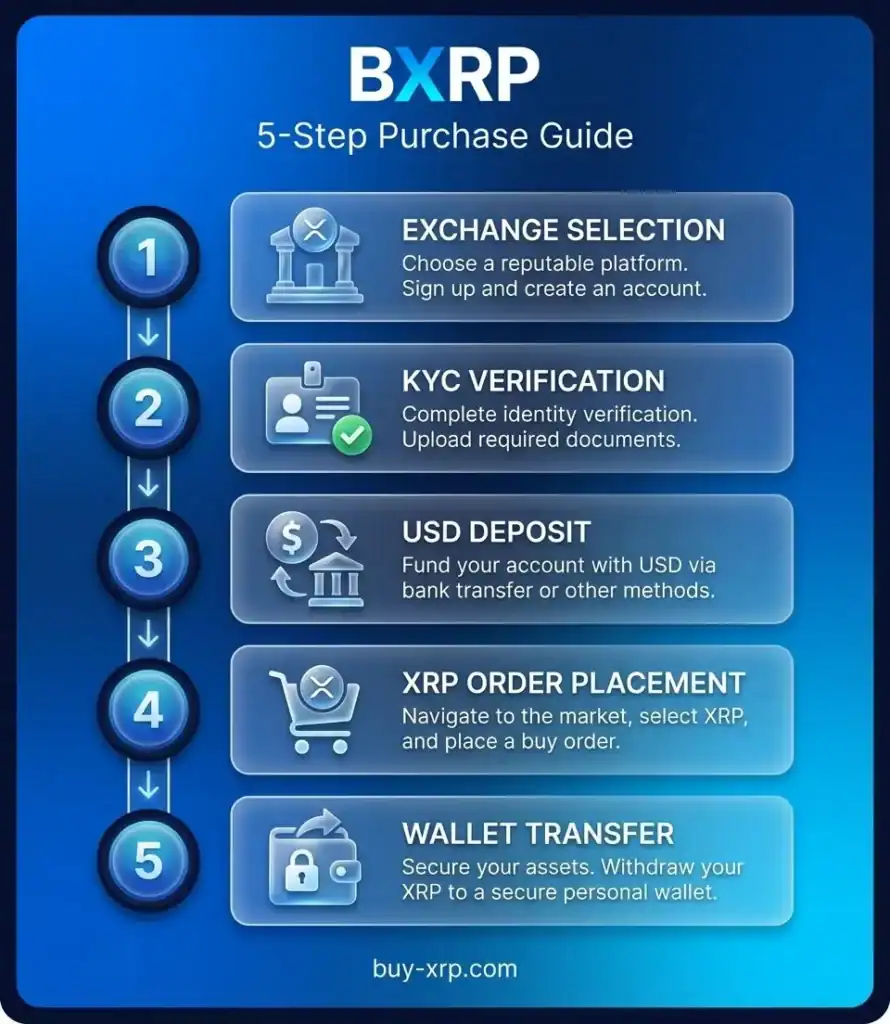
Buying XRP requires five steps: choose a cryptocurrency exchange, create and verify your account with government ID, deposit funds via bank transfer or card, search for XRP, and place a buy order.
The entire process takes 10–30 minutes if your exchange approves identity verification quickly. Some exchanges complete KYC checks in under two minutes through automated document scanning, while others require up to 72 hours for manual review (Coinbase Help Center, 2025, “most verifications approved in minutes”; Kraken Support, 2025, “verification typically within minutes”). The five steps below apply regardless of which exchange or payment method you choose.
Step 1: Choose a cryptocurrency exchange. Select a regulated exchange that supports XRP trading and accepts your preferred payment method. Coinbase, Kraken, and Binance are the three largest platforms by XRP trading volume in 2026. Each charges different fees and supports different deposit methods, so your choice depends on whether you prioritize low costs, fast funding, or a beginner-friendly interface. US residents should confirm the exchange operates in their state, as some platforms restrict access in certain jurisdictions due to state-level licensing requirements.
Key factors to evaluate when choosing an exchange include: the fee structure (maker-taker percentage, spread, or flat fee), supported deposit methods (bank transfer, card, PayPal), whether the platform allows XRP withdrawals to external wallets, the exchange’s security track record and insurance coverage, and the quality of customer support. Coinbase is publicly traded on Nasdaq (ticker: COIN) and subject to SEC reporting requirements, which provides an additional layer of financial transparency. Kraken publishes Proof of Reserves audits conducted by third-party firms, verifying that customer deposits are fully backed. Binance maintains a Secure Asset Fund for Users (SAFU)—a $1 billion insurance reserve created in 2018 to protect users in the event of a security breach.
Step 2: Create and verify your account. Register with your email address and create a strong password with at least 12 characters including uppercase letters, numbers, and special characters. Every regulated exchange requires Know Your Customer (KYC) verification before you can deposit funds or trade. KYC is mandated by the Bank Secrecy Act (BSA) and anti-money laundering (AML) regulations enforced by FinCEN in the United States and equivalent agencies globally.
KYC verification involves uploading a government-issued photo ID—such as a passport, driver’s license, or national identity card—and completing a selfie verification to confirm your identity. Some exchanges also request proof of address through a utility bill or bank statement dated within the last 90 days. The process protects both the platform and its users by preventing fraud, identity theft, and illicit financial activity.
Automated verification systems on Coinbase and Kraken typically approve accounts in 1–5 minutes using optical character recognition (OCR) to scan and validate documents in real time. Binance’s global platform processes most verifications within 10 minutes. Delays beyond 24 hours usually indicate a document quality issue—blurry images, expired IDs, or mismatched names between your ID and account registration. If your verification is rejected, resubmit with a clearer photo taken in good lighting against a plain background, ensuring all four corners of the document are visible.
Step 3: Deposit funds. Add money to your exchange account using a bank transfer, credit card, debit card, or digital wallet. Bank transfers (ACH in the US, SEPA in Europe, Faster Payments in the UK, Interac e-Transfer in Canada) typically carry the lowest fees—often free on Coinbase and Kraken—but take 1–5 business days to settle. Debit and credit card deposits via Visa, Mastercard, or American Express process instantly but cost 1.8–3.99% depending on the exchange, which matters when calculating your total cost of buying XRP. If you prefer faster access without the high card fees, you can purchase XRP using PayPal on platforms that support it, with funds available immediately and lower fees than card deposits. Apple Pay and Google Pay are accepted on Binance and some regional exchanges, providing another instant funding option with fees comparable to debit card rates.
Step 4: Find XRP on the exchange. Navigate to the exchange’s trading section and search for “XRP” or the trading pair “XRP/USD.” Most exchanges display XRP prominently in their asset listings. On Coinbase, tap “Buy & Sell” and search for XRP. On Kraken, select “Buy Crypto” and choose XRP from the asset list. On Binance, navigate to “Trade” and search for the XRP/USDT pair. Confirm you are selecting XRP (also listed as Ripple on some platforms) and not a similarly named token.
Step 5: Place your buy order. Enter the amount of XRP you want to purchase—either by specifying a dollar amount or an XRP quantity—and review the order summary. The summary displays the current XRP price, the exchange’s fee, and the total cost. Confirm the order to execute the purchase. Your XRP appears in your exchange wallet within seconds. Most exchanges allow purchases starting from $1–$10, making it accessible for first-time buyers testing with a small amount before committing larger sums.
Can You Buy XRP in the USA?
Yes. XRP is fully available for purchase by US residents on all major cryptocurrency exchanges, including Coinbase, Kraken, Robinhood, and Gemini. Between January 2021 and the SEC settlement in August 2025, several US exchanges had suspended XRP trading due to regulatory uncertainty surrounding the SEC v. Ripple lawsuit (SEC v. Ripple Labs Inc., Case No. 20-cv-10832, S.D.N.Y.). Judge Analisa Torres ruled in July 2023 that XRP sold on public exchanges does not constitute a security under the Howey Test. Both Ripple and the SEC dropped their appeals in August 2025, making that ruling final and permanent (Second Circuit Joint Stipulation of Dismissal, August 7, 2025). Following the settlement, Coinbase relisted XRP in February 2023 after the partial ruling, and by late 2025 every major US platform had restored full XRP trading access. US residents can also gain XRP exposure through spot XRP ETFs, which began trading on US stock exchanges in November 2025. Since which exchange you choose directly affects the fees you pay and the payment methods available, selecting the right platform is the next critical decision.
Where Can You Buy XRP?
XRP is available on major cryptocurrency exchanges including Coinbase, Binance, Kraken, and Robinhood. US residents have the most options since the SEC lawsuit settlement in August 2025 restored XRP trading across all major platforms.
The exchange you choose affects your fees, available payment methods, and whether you can withdraw XRP to a personal wallet. The table below compares the four most popular XRP exchanges for US buyers across the attributes that matter most: trading fees, deposit methods, withdrawal capability, and security features. Fee data is sourced from each exchange’s official fee schedule as of February 2026 (Coinbase Advanced Fee Schedule, 2026; Kraken Fee Schedule, 2026; Binance Fee Structure, 2026).
| Exchange | Trading Fees | Card Fee | Deposit Methods | XRP Withdrawal | Security |
|---|---|---|---|---|---|
| Coinbase | 0.60% / 1.20% | Spread | Bank (free), PayPal, Visa/MC | Yes (~0.25 XRP) | Cold storage, FDIC, SOC 2 |
| Binance | 0.10% / 0.10% | 1.8% | Bank, Visa/MC, P2P, Apple Pay | Yes (0.25 XRP) | SAFU $1B fund, cold storage |
| Kraken | 0.25% / 0.40% | 3.75% | Bank, wire, ACH, Visa/MC | Yes (0.02 XRP) | 95% cold, Proof of Reserves |
| Robinhood | 0% (spread) | N/A | Bank transfer (free) | No | SIPC insured, state licensed |
Coinbase is the most widely used exchange for US-based XRP buyers. It offers a simple interface, free ACH deposits, and PayPal funding. Its Advanced Trade platform provides lower fees for active traders who place limit orders. Coinbase supports XRP/USD trading with deep liquidity, and its mobile app allows one-tap purchases from a linked bank account or card. As of 2026, Coinbase reports over 100 million verified users globally. For buyers prioritizing ease of use and regulatory compliance, Coinbase is the standard starting point. See our step-by-step guide to buying XRP on Coinbase for the complete walkthrough.
Binance charges the lowest explicit trading fees at 0.10% per trade, making it the most cost-effective platform for larger or frequent purchases. Its global platform supports XRP/USDT, XRP/BTC, XRP/EUR, and XRP/FDUSD trading pairs with deep liquidity and tight spreads. Binance also offers a peer-to-peer (P2P) marketplace where buyers purchase XRP directly from sellers using over 100 fiat currencies and more than 800 local payment methods—useful for buyers in regions with limited banking access. US residents access Binance through its US-specific platform, which has a more limited feature set than the global version but maintains the same low fee structure. For buyers focused on minimizing trading costs, see our guide to buying XRP on Binance for lower fees.
Kraken offers the lowest XRP withdrawal fee at just 0.02 XRP—approximately $0.03 at current prices—compared to 0.25 XRP on Coinbase and Binance. This makes Kraken the best choice for buyers who plan to transfer XRP to a personal wallet for self-custody after purchase. Founded in 2011, Kraken is one of the longest-operating cryptocurrency exchanges and has never been hacked. It publishes Proof of Reserves audits, allowing users to cryptographically verify the exchange holds sufficient assets to cover all deposits. Kraken supports ACH transfers (free), wire transfers ($5), and card purchases (3.75% fee). Explore Kraken’s XRP trading platform for detailed instructions.
Robinhood charges no explicit trading fees, but it applies a spread—the difference between the buy and sell price—that typically ranges from 0.50% to 1.50%. While this appears cheaper on the surface, the effective cost per trade often exceeds Binance’s 0.10% fee and approaches Coinbase’s rates. Robinhood restricts XRP withdrawals to external wallets, meaning you cannot transfer your XRP to a hardware wallet or another exchange. For buyers who want full ownership and self-custody of their XRP, a platform that supports withdrawals is essential.
What Is the Best App to Buy XRP?
The best app depends on your priorities. Coinbase offers the most intuitive mobile experience with one-tap XRP purchases and instant bank funding. Kraken’s mobile app provides lower withdrawal fees and Proof of Reserves transparency. Binance delivers the lowest trading fees on its mobile app, though its interface is more complex and better suited to users with some trading experience. For US residents buying XRP for the first time, Coinbase’s app provides the simplest path from account creation to purchase completion. Regardless of which platform you select, the account setup requirements are largely the same across all exchanges.
What Do You Need to Buy XRP?
Buying XRP requires a cryptocurrency exchange account, government-issued photo ID for KYC verification, a funded payment method such as a bank account or credit card, and an email address. Most exchanges approve accounts within minutes.
Here is the complete checklist of what you need before you start:
Identity verification documents. All regulated exchanges require government-issued identification to comply with anti-money laundering (AML) regulations and Know Your Customer (KYC) requirements under the Bank Secrecy Act (31 U.S.C. § 5318). FinCEN’s Customer Due Diligence Rule, effective May 2018, further requires financial institutions—including cryptocurrency exchanges registered as Money Services Businesses—to verify and maintain records of customer identities (31 CFR § 1010.230). Accepted documents include a passport, driver’s license, or national identity card. The document must be current (not expired), and the name on the ID must match the name on your exchange account exactly. Many exchanges also require a live selfie or video verification to confirm the person submitting the ID is the account holder. Non-US residents may need to submit a proof of address document—such as a bank statement or utility bill dated within 90 days—as an additional verification step. Higher verification tiers unlock larger deposit and withdrawal limits: Coinbase’s basic verification allows up to $25,000 in daily purchases, while enhanced verification can raise that limit significantly.
A funded payment method. You need at least one of the following connected to your exchange account: a bank account (checking or savings) for ACH or wire transfers, a Visa or Mastercard debit card for instant deposits, a credit card (where accepted—some exchanges and card issuers restrict credit card crypto purchases), or a digital wallet like PayPal, Apple Pay, or Google Pay on supporting platforms. Bank transfers cost the least—often $0 on major exchanges—but take 1–5 business days to clear. Card payments settle instantly but carry fees between 1.8% and 3.99%. According to a 2025 Chainalysis report, bank transfers account for the majority of fiat-to-crypto deposits globally, while card purchases dominate among first-time buyers who prioritize speed over cost.
A valid email address and phone number. Your email serves as your account login and recovery method. Your phone number is required for two-factor authentication (2FA), which every exchange strongly recommends or requires. Enable an authenticator app (such as Google Authenticator or Authy) rather than SMS-based 2FA for stronger security, as SIM-swap attacks can compromise SMS codes.
Minimum purchase amount. Most exchanges set a minimum buy amount between $1 and $10. Coinbase allows purchases starting at $1. Kraken’s minimum is $10. Binance accepts buys from $10 when using a card or from $1 on its spot trading interface. There is no minimum amount of XRP you must hold on an exchange—the 1 XRP base reserve applies only to self-custodied XRP Ledger wallets, not exchange accounts.
Stable internet access. Cryptocurrency transactions execute in real time. A dropped connection during order placement can result in a failed or duplicate transaction. Use a secure, private network—avoid public Wi-Fi when accessing your exchange account or entering payment details.
Once your account is set up, funded, and ready to trade, the next consideration is understanding exactly how much each XRP purchase will cost you beyond the token’s market price.
How Much Does It Cost to Buy XRP?
Buying XRP involves three fee types: deposit fees (0–3.99% depending on payment method), trading fees (0.10–1.20% per transaction depending on exchange), and withdrawal fees (0.02–0.25 XRP flat). Card deposits carry the highest fees.
Understanding these three cost layers helps you minimize the total expense of each XRP purchase. The cheapest combination on any exchange is a free bank transfer deposit paired with a limit order, which uses the lower maker fee tier. All fee data below is sourced from each exchange’s official fee schedule as of February 2026 (Coinbase Advanced Fee Schedule, 2026; Kraken Fee Schedule, 2026; Binance Fee Structure, 2026).
Deposit fees vary entirely by payment method:
| Payment Method | Fee Range | Processing Time | Availability |
|---|---|---|---|
| ACH Bank Transfer | Free | 1–5 business days | US only |
| SEPA Transfer | Free–€1.00 | 1–2 business days | EU/UK |
| Debit Card (Visa/MC) | 1.8%–3.99% | Instant | Global |
| Credit Card (Visa/MC/Amex) | 2.49%–3.99% | Instant | Where accepted |
| PayPal | 0%–2.5% | Instant | US, EU, select countries |
Trading fees apply when you execute a buy or sell order. Most exchanges use a maker-taker fee model. Maker orders (limit orders that add liquidity to the order book) cost less than taker orders (market orders that remove liquidity). At the lowest tier on each exchange: Binance charges 0.10% for both makers and takers. Kraken charges 0.25% maker and 0.40% taker. Coinbase charges 0.60% maker and 1.20% taker on its Advanced Trade platform. These percentages apply to the total trade value—so a 0.10% fee on a $500 purchase equals $0.50.
Higher trading volumes unlock lower fee tiers on all three platforms. On Coinbase, trading over $10,000 in a 30-day period reduces fees to 0.25% maker and 0.40% taker. On Kraken, the same volume threshold drops fees to 0.20% maker and 0.35% taker. Binance’s VIP 1 tier (over $1 million in 30-day volume) reduces fees to 0.09% maker and 0.10% taker. For most retail XRP buyers making occasional purchases, the base tier fees are what apply.
To illustrate the impact: on a $1,000 XRP purchase using a bank transfer deposit and a limit order, total fees would be approximately $1.00 on Binance, $2.50 on Kraken, and $6.00 on Coinbase. Over 12 monthly purchases totaling $12,000, the difference between Binance and Coinbase amounts to $60. For a buyer purchasing $100 of XRP weekly through dollar-cost averaging, annual fee savings of switching from Coinbase to Binance total approximately $260.
Withdrawal fees apply when you transfer XRP from the exchange to a personal wallet. These are denominated in XRP, not dollars. Kraken charges just 0.02 XRP (approximately $0.03). Binance and Coinbase each charge approximately 0.25 XRP ($0.34). Robinhood does not currently support XRP withdrawals. For buyers who plan to hold XRP on the exchange rather than transfer to a wallet, withdrawal fees are not a factor.
To compare all XRP exchanges side by side across fees, security features, and supported countries, see our complete exchange comparison guide.
Can You Buy XRP with No Fees?
No exchange offers truly zero-fee XRP trading. Robinhood advertises $0 commissions but applies a spread—typically 0.50–1.50%—that functions as a hidden fee embedded in the price you pay. On a $1,000 purchase, Robinhood’s spread costs $5–$15 in practice. Coinbase One subscribers ($29.99/month) receive zero trading fees with a spread, which benefits frequent traders making multiple purchases per month. The closest to zero-fee trading is Binance’s spot platform at 0.10% per trade with a free bank transfer deposit—totaling just $1.00 in fees on a $1,000 buy.
With fees understood, many buyers also want to know whether XRP makes sense as a long-term holding rather than just a one-time purchase.
Can You Buy XRP as an Investment?
XRP can be purchased as a long-term investment through cryptocurrency exchanges or through XRP ETFs available at traditional brokerages. XRP is a cryptocurrency, not a stock, though ETFs provide stock-like access through regulated investment accounts.
Buyers who approach XRP as an investment rather than a one-time transaction have two purchase channels, each with different account requirements, fee structures, and custody models.
Direct purchase on a cryptocurrency exchange gives you ownership of actual XRP tokens. You control the asset, can transfer it to a personal wallet for self-custody, and retain full flexibility to sell, trade, or use the XRP at any time. This method uses the same exchange account and verification process described in this guide. The primary costs are the trading fee (0.10–1.20% per transaction) and any deposit fee from your chosen funding method. Direct purchase is the better option for buyers who want to hold XRP in their own wallet, use dollar-cost averaging to accumulate over time, or maintain the ability to transfer XRP between platforms.
XRP ETF purchase through a brokerage account provides XRP price exposure without requiring a cryptocurrency exchange account, private keys, or wallet management. Spot XRP ETFs began trading on US exchanges in November 2025 following SEC approval (SEC Release No. 34-101562, October 2025), and multiple providers now offer them through standard brokerage platforms (Nasdaq, NYSE Arca, Cboe BZX). Within their first three months of trading, XRP ETFs collectively attracted over $1 billion in net inflows (Bloomberg ETF data, February 2026), indicating strong institutional and retail demand for regulated XRP exposure. ETFs allow XRP exposure inside IRAs, 401(k)s, and taxable brokerage accounts—making them the simplest option for buyers who already have a brokerage account and prefer not to manage cryptocurrency directly. ETF investors pay a sponsor fee (typically 0.19–0.50% annually) rather than per-transaction exchange fees.
For a detailed comparison of available XRP ETFs, including sponsor fees, fund sizes, and performance tracking, see our dedicated XRP ETF guide. For buyers evaluating whether XRP fits their portfolio, our XRP investment analysis covers the investment case, risks, and price history in depth. For background on the asset itself, see understanding what XRP is before you buy.
Cryptocurrency investments carry risk, and past performance does not predict future results. Buyers should invest only what they can afford to lose. This content is educational and does not constitute financial advice.
Whether you buy XRP directly or through an ETF, many buyers arrive at this step after searching for “XRP stock”—which reflects a common but important misconception about what XRP actually is.
How Do You Buy XRP Stock?
XRP is not a stock—it is a cryptocurrency purchased through exchanges like Coinbase or Kraken. Buyers who want stock-like access can purchase spot XRP ETFs through traditional brokerage accounts on Nasdaq, NYSE Arca, or Cboe BZX.
The search query “how to buy XRP stock” is one of the most common XRP-related searches, but it reflects a misconception. XRP is a digital asset on the XRP Ledger, not equity in a company. Owning XRP does not represent shares in Ripple Labs or any other corporation. XRP holders have no voting rights, no claim on corporate profits, and no dividends. XRP’s value derives from supply, demand, and network utility—not from a company’s earnings or revenue (SEC v. Ripple Labs Inc., Case No. 20-cv-10832, S.D.N.Y.; Judge Torres ruled in July 2023 that XRP sold on exchanges does not constitute a security under the Howey Test).
Buyers who want to purchase XRP through a stock-like interface have two options. First, spot XRP ETFs—which began trading on US exchanges in November 2025 following SEC approval (SEC Release No. 34-101562, October 2025)—allow XRP price exposure inside IRAs, 401(k)s, and standard brokerage accounts. ETF investors pay an annual sponsor fee (typically 0.19–0.50%) rather than per-trade exchange fees. Second, Robinhood’s brokerage app lists XRP alongside stocks in its trading interface, providing a familiar experience for stock traders, though it does not support XRP withdrawals to external wallets.
For buyers who want actual ownership of XRP tokens with full self-custody capability, a cryptocurrency exchange remains the correct purchase method. The step-by-step process described in this guide applies regardless of whether you are coming from a stock trading background or purchasing cryptocurrency for the first time. Understanding what happens after your purchase—including custody, recurring buys, and tax obligations—is the final step.
What Happens After You Buy XRP?
After buying XRP, your tokens are held in your exchange account by default. You can hold them there, transfer them to a personal wallet for self-custody, or set up recurring purchases to build your position over time through dollar-cost averaging.
Each post-purchase option involves different tradeoffs between convenience and security.
Holding XRP on the exchange is the simplest option and requires no additional setup. Your XRP remains accessible for trading—you can sell it at any time. Major exchanges like Coinbase, Kraken, and Binance hold the majority of customer funds in cold storage (offline wallets disconnected from the internet) and offer FDIC insurance on US dollar deposits (Coinbase 10-K Annual Report, 2025, “approximately 98% of customer crypto assets stored offline”). The risk is that the exchange controls your private keys—not you. If the exchange experiences a security breach or financial collapse, your funds may be at risk. The cryptocurrency industry adage “not your keys, not your coins” reflects this tradeoff.
Transferring XRP to a personal wallet gives you full custody of your tokens. You control the private keys, and no third party can freeze, seize, or restrict access to your XRP. This is the recommended approach for buyers holding significant amounts or planning to hold long-term. Transferring XRP from an exchange involves copying your wallet address, pasting it into the exchange’s withdrawal form, entering the amount, and confirming. The process completes in 3–5 seconds on the XRP Ledger, with withdrawal fees ranging from 0.02 to 0.25 XRP depending on the exchange. For a complete guide to choosing a wallet, setting up self-custody, and understanding XRP Ledger reserve requirements, see our XRP wallet guide.
Setting up recurring purchases allows you to buy a fixed dollar amount of XRP at regular intervals—daily, weekly, or monthly—regardless of the current price. This strategy, called dollar-cost averaging (DCA), reduces the impact of short-term price volatility on your average purchase price. Coinbase, Kraken, and Binance all support automated recurring buys through their mobile apps and web interfaces.
On Coinbase, navigate to XRP, tap “Buy,” select “Repeat,” and choose your frequency and amount. On Kraken, set up recurring buys through the “Buy Crypto” section with daily, weekly, biweekly, or monthly frequency options. On Binance, the “Auto-Invest” feature allows recurring purchases with custom intervals.
For a $100 weekly DCA strategy, you would accumulate approximately $5,200 worth of XRP annually, with your average cost smoothing out the peaks and valleys of price fluctuations. DCA does not guarantee profits or protect against losses in a sustained downtrend, but it eliminates the risk of investing an entire lump sum at a market peak.
Monitoring your position involves tracking XRP’s price and your portfolio’s value through your exchange’s portfolio view, a dedicated portfolio tracker app, or blockchain explorers like XRPScan for on-chain verification of wallet balances and transaction history.
Is It Safe to Buy XRP?
Buying XRP on a regulated exchange with cold storage, two-factor authentication, and deposit insurance is as safe as purchasing any major cryptocurrency. The primary risks are price volatility and exchange security, both mitigable through proper security practices and self-custody.
The safety of buying XRP depends on two factors: the security of your chosen exchange and your personal account protection measures.
Exchange security. Major platforms maintain robust protections. Coinbase stores approximately 98% of customer crypto assets in offline cold storage and maintains FDIC insurance on USD cash balances up to $250,000 (Coinbase 10-K Annual Report, 2025). Kraken, operating since 2011 without a security breach, publishes semi-annual Proof of Reserves audits conducted by independent firms, allowing users to cryptographically verify their deposits are fully backed. Binance maintains its $1 billion SAFU insurance fund, established in July 2018, specifically to cover customer losses from security incidents.
Account security. Enable two-factor authentication using an authenticator app (Google Authenticator, Authy) rather than SMS, as SIM-swap attacks remain the most common vector for account compromise. Use a unique, strong password of at least 12 characters. Never share your exchange login credentials or private keys. For holdings above $1,000, consider transferring XRP to a personal wallet for self-custody—removing exchange counterparty risk entirely.
Price risk. XRP’s market price can fluctuate 10–20% in a single week. This is inherent to all cryptocurrencies and is not a security flaw—it is market volatility. Buyers should invest only amounts they can afford to lose and consider dollar-cost averaging to reduce the impact of short-term price swings.
Understanding tax obligations. In the United States, the IRS classifies cryptocurrency as property (IRS Notice 2014-21). Every sale, trade, or conversion of XRP is a taxable event that may generate a capital gain or loss. If you buy XRP and hold it for more than one year before selling, any profit is taxed at the long-term capital gains rate (0%, 15%, or 20% depending on income). If you sell within one year, the short-term rate applies, which matches your ordinary income tax bracket. Most exchanges provide downloadable transaction history that can be imported into tax software. Keep records of every purchase date, amount, price paid, and any fees, as these establish your cost basis for calculating gains or losses. Consult a tax professional for guidance specific to your situation.
With the full purchase and post-purchase process covered, the following section provides a simplified overview for first-time buyers, followed by answers to the most common remaining questions.
How Do You Buy XRP for Beginners?
Beginners buy XRP by creating a verified account on Coinbase or Kraken, depositing funds via bank transfer or debit card, and placing an XRP buy order. The process takes under 30 minutes with no prior cryptocurrency experience required.
If the detailed steps above feel overwhelming, here is the simplified beginner path using Coinbase—the most popular exchange among first-time XRP buyers (Coinbase, 2025, “over 100 million verified users globally”).
Create your account (5 minutes). Download the Coinbase app or visit coinbase.com. Register with your email, create a password, and upload your driver’s license or passport for identity verification. Coinbase’s automated system typically approves accounts in 1–5 minutes.
Add money (1–3 minutes). Link your bank account for free ACH deposits, or use a debit card for instant funding at a 3.99% fee. A bank transfer is recommended for first-time buyers because it carries no fees—though it takes 1–5 business days to settle.
Buy XRP (1 minute). Tap “Buy & Sell,” search for XRP, enter the dollar amount you want to spend (starting from as little as $1), review the fee summary, and confirm. Your XRP appears in your Coinbase account within seconds.
From there, you can hold your XRP on the exchange, transfer it to a personal wallet for self-custody, or set up recurring purchases to build your position over time. Each of these post-purchase options is covered in detail in the section above.
The following questions address the most common remaining concerns new XRP buyers have.
Frequently Asked Questions About Buying XRP
How do I buy XRP?
Create an account on a cryptocurrency exchange such as Coinbase or Kraken. Complete identity verification by uploading a government-issued ID. Deposit funds using a bank transfer, debit card, or PayPal. Search for XRP in the exchange’s asset list, enter the amount you want to buy, and confirm the order.
How can I buy XRP?
XRP is purchasable through centralized cryptocurrency exchanges (Coinbase, Binance, Kraken, Gemini), brokerage platforms like Robinhood, spot XRP ETFs on stock exchanges (Nasdaq, NYSE Arca, Cboe BZX), or the XRP Ledger’s built-in decentralized exchange. Centralized exchanges offer the widest payment support for most buyers. ETFs suit investors who prefer existing brokerage accounts.
Where can I buy XRP in the USA?
US residents can buy XRP on Coinbase, Kraken, Robinhood, Gemini, and the US version of Binance. All major US exchanges restored full XRP trading after the SEC v. Ripple lawsuit concluded in August 2025. Availability may vary by state due to local licensing requirements—check your exchange’s supported states list.
How to buy XRP online?
Visit a cryptocurrency exchange website or download its mobile app. Register an account, verify your identity with a government-issued ID, deposit funds via bank transfer or card, and purchase XRP through the platform’s trading interface. The entire process—from registration to first purchase—completes within 15–30 minutes on most exchanges.
What is the best app to buy XRP?
Coinbase offers the simplest interface for first-time buyers with free bank deposits. Kraken provides the lowest withdrawal fees for self-custody transfers. Binance delivers the lowest trading fees at 0.10% per trade. The best app depends on whether you prioritize simplicity, low fees, or advanced features.
How to buy XRP with no fees?
Zero-fee XRP purchases do not exist on any platform. The lowest-cost method is depositing via a free bank transfer and placing a limit order on Binance (0.10% fee) or Kraken (0.25% fee). Coinbase One subscribers pay no explicit trading fees but still face a spread. Robinhood’s “commission-free” model embeds fees in the spread between buy and sell prices.
What is the minimum amount of XRP I can buy?
Most exchanges allow XRP purchases starting from $1–$10. Coinbase’s minimum is $1. Kraken and Binance set minimums at $10 for card purchases, though spot trading on Binance accepts smaller amounts. There is no network-imposed minimum for buying XRP on an exchange—the 1 XRP wallet reserve applies only when creating a self-custodied wallet on the XRP Ledger.